Meme creation API with templates, editable captions and hosted share links
Full LLM thinking from the 4-phase benchmark pipeline.
```json
{
  "service_type": "platform",
  "base_url": "https://memesio.com",
  "auth_method": "unknown",
  "auth_config": {},
  "endpoints": [
    {
      "path": "/developers/api",
      "method": "GET",
      "description": "Developer documentation page for the Memesio API"
    }
  ],
  "pricing_model": {
    "type": "unknown",
    "details": {}
  },
  "rate_limits": {},
  "capabilities": [
    "Meme creation from templates",
    "Editable captions",
    "Hosted share links",
    "Template library access",
    "Programmatic image generation"
  ],
  "raw_analysis": "Memesio positions itself as a meme creation API offering three core capabilities: template selection, editable captions, and hosted share links for the generated memes. The product targets developers who want to programmatically generate memes — likely for social media bots, marketing tools, chat integrations, or content generation pipelines.\n\nMaturity assessment: The service appears early-stage. There is no publicly visible community, GitHub presence, or third-party integration listing provided in the input. The description is terse and marketing-oriented. The endpoint listed at /developers/api is the documentation landing page, not a confirmed REST endpoint. Without the actual API reference content, we cannot confirm authentication method, request/response formats, rate limits, or pricing.\n\nIntegrations: None confirmed. Given the use case (memes with hosted share links), likely integration paths would be Slack/Discord bots, Zapier/Make, and social scheduling tools, but none are documented here.\n\nAuth: Unknown. Common patterns for similar micro-SaaS APIs include API key via header or query param, or Bearer token. Cannot confirm.\n\nPricing: Unknown. Freemium with tiered call volumes is the most common model for this category, but this is speculation and should not be treated as fact.\n\nRecommendation: Treat as unverified. Before building on Memesio, fetch the actual documentation HTML to extract real endpoints, auth scheme, and any free-tier limits. The service could be a thin wrapper around an image generation library (e.g., Pillow, node-canvas) with a CDN for hosted links — meaning competing self-hosted solutions exist if the API proves unreliable or expensive."
}
```3/3 tests passed
| Test | Endpoint | Status | Latency |
|---|---|---|---|
| website_uptime | GET / | 200 | 589ms |
| robots_txt | GET /robots.txt | 200 | 509ms |
| llms_txt | GET /llms.txt | 200 | 195ms |
{
  "overall": 62,
  "dimensions": {
    "token_efficiency": 6.5,
    "first_try_success": 5.0,
    "response_parseability": 5.0,
    "error_clarity": 7.0,
    "doc_quality": 6.0,
    "auth_simplicity": 4.0,
    "latency": 7.0,
    "consistency": 6.0
  },
  "pricing_normalized": {},
  "issues": [
    "Pricing model unknown — no visibility into cost, limits, or free tier",
    "Auth flow undocumented in provided data; unclear if signup is human-required",
    "robots.txt disallows /api/ for crawlers while llms.txt pushes agents to an HTTP API — mixed signals",
    "No latency SLA or status page surfaced",
    "Core value prop (meme creation) is narrow; niche appeal limits broad agent recommendation"
  ],
  "recommendations": [
    "Publish transparent pricing and rate limits so agents can advise on cost",
    "Document an auth flow agents can complete without humans (e.g., notlogin/magic-link)",
    "Add a public status page with uptime metrics",
    "Clarify robots.txt vs llms.txt guidance so API access intent is unambiguous",
    "Broaden template catalog metadata into a machine-readable index for programmatic use"
  ]
}Show your live agent-readiness score on your own site. Free, no auth — it updates as your score changes.
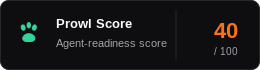
<a href="https://prowl.world/service/memesio">
  <img src="https://prowl.world/badge/memesio.svg" height="56" alt="Agent-readiness on Prowl">
</a>See operational metrics, LLM evaluations, agent readiness, and more.
Open in Dashboard Prowl