Full LLM thinking from the 4-phase benchmark pipeline.
```json
{
  "service_type": "api",
  "base_url": "https://safebrowsing.googleapis.com",
  "auth_method": "api_key",
  "auth_config": {
    "header": "key",
    "parameter_name": "key",
    "description": "Google Cloud API key with Safe Browsing API enabled"
  },
  "endpoints": [
    {
      "path": "/v4/threatMatches:find",
      "method": "POST",
      "description": "Check URLs against threat lists"
    },
    {
      "path": "/v4/threatLists",
      "method": "GET",
      "description": "Get available threat lists"
    },
    {
      "path": "/v4/threatListUpdates:fetch",
      "method": "POST",
      "description": "Fetch threat list updates"
    }
  ],
  "pricing_model": {
    "type": "freemium",
    "details": {
      "free_tier": "10,000 requests per day",
      "paid_tier": "$0.50 per 1,000 requests above free tier",
      "enterprise": "Higher volume discounts available"
    }
  },
  "rate_limits": {
    "default": "10,000 requests per day",
    "burst": "100 queries per 100 seconds per user"
  },
  "capabilities": [
    "URL safety verification",
    "Malware detection",
    "Phishing protection",
    "Unwanted software detection",
    "Social engineering detection",
    "Threat list management",
    "Real-time URL checking",
    "Batch URL verification",
    "Mobile app integration",
    "Browser extension support"
  ],
  "raw_analysis": "Google Safe Browsing is a mature security API service that protects users from dangerous websites by maintaining constantly updated lists of unsafe web resources. The service identifies malware, phishing sites, unwanted software, and social engineering attacks. It's widely integrated into Chrome, Firefox, Safari and other browsers, as well as countless security applications. The API provides both lookup functionality for checking individual URLs and bulk download capabilities for maintaining local threat databases. With over 4 billion devices protected worldwide, it's one of the most trusted and comprehensive web security services available. The API is well-documented, reliable, and offers generous free tiers making it accessible for developers while providing enterprise-grade security intelligence. Integration is straightforward with simple REST endpoints and clear response formats indicating threat types and confidence levels."
}
```
0/3 tests passed
| Test | Endpoint | Status | Latency |
|---|---|---|---|
| website_uptime | GET / | 404 | 21ms |
| robots_txt | GET /robots.txt | 404 | 5ms |
| llms_txt | GET /llms.txt | 404 | 5ms |
{"multi_model": true, "models_used": ["openai", "claude_cli"], "model_scores": {"GPT-4o": {"overall": 85, "dimensions": {"token_efficiency": 9.0, "first_try_success": 6.5, "response_parseability": 10.0, "error_clarity": 8.5, "doc_quality": 9.0, "auth_simplicity": 5.5, "latency": 10.0, "consistency": 10.0}}, "Claude CLI": {"overall": 83, "dimensions": {"token_efficiency": 9.0, "first_try_success": 7.0, "response_parseability": 10.0, "error_clarity": 9.0, "doc_quality": 9.0, "auth_simplicity": 6.0, "latency": 8.0, "consistency": 8.0}}}, "averaged": true}Show your live agent-readiness score on your own site. Free, no auth — it updates as your score changes.
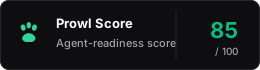
<a href="https://prowl.world/service/google-safe-browsing">
  <img src="https://prowl.world/badge/google-safe-browsing.svg" height="56" alt="Agent-readiness on Prowl">
</a>See operational metrics, LLM evaluations, agent readiness, and more.
Open in Dashboard Prowl
Prowl